


Military Pay
2025 Military Pay Charts
Military members saw a 4.5% increase in 2025, with junior enlisted members seeing an additional 10% boost in the spring to bring the raise to roughly 14.5%.
The Muster Duty Allowance (MDA) is a taxable, flat-rate annual payment made to Individual Ready Reserve (IRR) members who complete their mandatory yearly muster duty screening. The 2026 rate is $286.25.
Veteran.com and Three Creeks Media, LLC, its parent and affiliate companies, may receive compensation through advertising placements on Veteran.com. For any rankings or lists on this site, Veteran.com may receive compensation from the companies being ranked; however, this compensation does not affect how, where, and in what order products and companies appear in the rankings and lists. If a ranking or list has a company noted to be a “partner,” the indicated company is a corporate affiliate of Veteran.com. No tables, rankings, or lists are fully comprehensive and do not include all companies or available products.
Veteran.com and Three Creeks Media have partnered with CardRatings for our coverage of credit card products. Veteran.com and CardRatings may receive a commission from card issuers when a customer clicks on a link, when an application is approved, or when an account is opened. American Express is an advertiser on Veteran.com. Terms Apply to American Express benefits and offers.
Opinions, reviews, analyses & recommendations are the author's alone and have not been reviewed, endorsed, or approved by any of these entities.
Inside This Article
If you are a member of the Individual Ready Reserve (IRR), veterans and former reservists who are no longer on active duty or drilling but remain subject to recall during a national emergency, you are required to complete muster duty once per year. When you do, you receive a one-time payment called the Muster Duty Allowance, or MDA.
The 2026 MDA rate is $286.25. MDA is not tax-free. Unlike Basic Allowance for Housing (BAH) or the Family Separation Allowance (FSA), Basic Allowance for Subsistence (BAS), MDA is subject to federal income taxes.
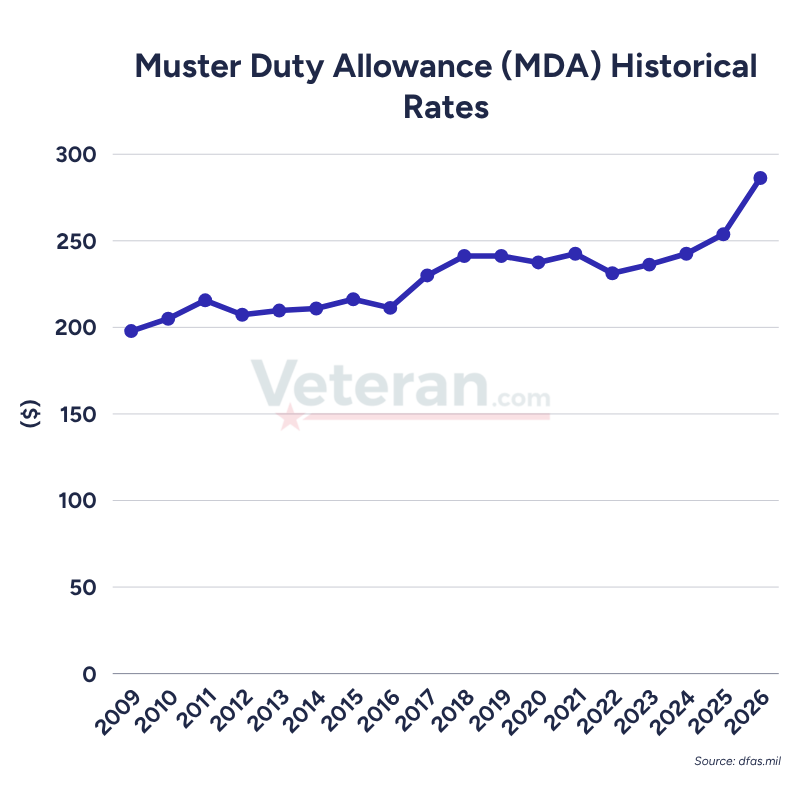
The table below shows the MDA rate for each year since 2009.
| Effective | Amount |
|---|---|
| Jan. 1, 2026 | $286.25 |
| Jan. 1, 2025 | $253.75 |
| Jan. 1, 2024 | $242.50 |
| Jan. 1, 2023 | $236.25 |
| Jan. 1, 2022 | $231.25 |
| Jan. 1, 2021 | $242.50 |
| Jan. 1, 2020 | $237.50 |
| Jan. 1, 2019 | $241.25 |
| Jan. 1, 2018 | $241.25 |
| Jan. 1, 2017 | $230 |
| Jan. 1, 2016 | $211.25 |
| Jan. 1, 2015 | $216.25 |
| Jan. 1, 2014 | $210.90 |
| Jan. 1, 2013 | $209.71 |
| Jan. 1, 2012 | $207.28 |
| Jan. 1, 2011 | $215.63 |
| Jan. 1, 2010 | $205 |
| Jan. 1, 2009 | $197.86 |
Source: Defense Finance and Accounting Service
That rate is set by federal law at 125 percent of the average domestic per diem rate for the continental United States as of September 30 of the prior year, under 37 U.S.C. § 433.
Muster duty applies to IRR members who are not in the National Guard or the Selected Reserve (SELRES). It does not apply to Active Guard Reserve (AGR) members, who serve full-time.
You remain in the IRR until your Military Service Obligation (MSO) is fulfilled. Something that may be a little unknown to folks who aren’t in the military, or dependents, is that all enlisted members incur an eight-year MSO when they take their oath of service. If you served four years on active duty, for example, you owe four more years in the IRR.
Officers also incur an eight-year MSO. After completing the MSO, officers transfer to the Non-Obligated Non-Participating Ready Reserve Personnel Section (NNRPS) for up to two years, or three years if you received separation pay.
Note: Receiving VA disability benefits does not excuse you from muster duty. If you are ordered to muster, you must complete it regardless of your VA rating or compensation status.
The MDA rate is set at 125 percent of the average per diem rate for the continental United States, excluding Alaska and Hawaii, as recorded on September 30 of the year before your muster. The U.S. General Services Administration (GSA) Office of Government-Wide Policy calculates the average domestic per diem rate, and DFAS applies the 125 percent formula to arrive at the MDA for the following year.
Because the GSA rate shifts with travel cost trends, the MDA does not increase every year in a straight line. You can see that reflected in the table above, where the rate dipped in some years and rose in others.
A muster event lasts a minimum of 2 hours and typically lasts 2 to 4 hours. It will not exceed a full duty day. Depending on your branch, your muster may be in person or virtual.
At a typical in-person muster, you can expect to:
A military uniform is not required. Dress should be neat and presentable.
If your muster is in-person, bring the following:
After your muster, your career counselor will complete a pay packet that includes your muster orders, a Career Counselor Guidance Form, an SF1199A direct deposit form, and a USARC Form 25R Certificate of Performance. Make sure your direct deposit information is accurate before you leave.
If your muster is virtual, you will log on to the virtual muster website using your Common Access Card (CAC) or Directory Server (DS) logon. You will update your personal information and certify your medical readiness online.
By law, the MDA is a single, flat-rate payment that covers everything related to your muster duty. It does not matter what grade or rank you hold. The allowance is intended as payment in full for:
You cannot receive both MDA and inactive-duty training pay under 37 U.S.C. § 206(a) for the same period. MDA is the only compensation you receive for muster duty.
Federal law requires MDA to be paid no later than 30 days after you complete muster duty. Payment may be made before, on, or after the day of your muster, as long as it falls within that 30-day window.
In practice, processing through DFAS typically takes 45 to 60 days. If your payment has not arrived after 60 days, contact your branch’s personnel office or DFAS directly.
Because MDA is subject to income taxes, the amount deposited to your account will be less than the published rate. Plan accordingly.
Missing muster duty without an approved exception has real consequences. Depending on your branch, you could be designated an unsatisfactory participant, which may result in:
Note: Missing muster does not protect you from future mobilization. If your grade or specialty is needed, you can still be recalled to active duty regardless of whether you completed your muster.
If you have a legitimate conflict, contact your branch’s IRR management office before your scheduled muster date. Acceptable reasons for excusal vary by branch but generally include federal employment TDY, documented medical situations, and similar circumstances. Civilian employment alone is not a valid excuse.
While the core requirements are the same across all branches, some details vary. Here is where to go for branch-specific information and contacts:
Is MDA taxable? Yes. MDA is subject to federal income taxes. This is different from allowances like BAH and FSA, which are tax-free. The published rate is your gross payment before taxes.
What is the 2026 MDA rate? The 2026 MDA rate is $286.25. It is a flat rate regardless of your grade or rank.
How is the MDA rate calculated? The MDA equals 125 percent of the average continental U.S. per diem rate as of September 30 of the prior year, under 37 U.S.C. § 433. The GSA calculates the average per diem rate, and DFAS applies the formula.
When will I receive my MDA payment? The law requires payment within 30 days of completing muster. In practice, DFAS processing takes approximately 45 to 60 days. If you have not received payment after 60 days, contact your branch personnel office or DFAS.
Do I have to attend muster if I receive VA disability benefits? Yes. VA benefits do not excuse you from muster duty. If you receive orders to muster, you must comply.
What happens if I miss muster duty? Missing muster without an approved exception can result in being designated an unsatisfactory participant. Consequences may include early discharge and loss of benefits at separation. It does not prevent future mobilization if your skills are needed.
Can I be promoted while in the IRR? It depends on your grade. Enlisted members in grades E-1 through E-4 are eligible for promotion while in IRR status. Enlisted members in grades E-5 and above must transfer to a Troop Program Unit (TPU) to be considered for promotion.
What is the difference between MDA and inactive-duty training pay? They are separate types of compensation and cannot be paid for the same period. If you receive MDA for muster duty, you cannot also receive inactive-duty training pay under 37 U.S.C. § 206(a) for that same day.
What is a virtual muster? A virtual muster lets you complete your annual screening online. You log on using your CAC or DS logon, update your personal information, and certify your medical readiness. Your branch will notify you if you are assigned a virtual muster rather than an in-person one.Who calculates the MDA rate each year? The GSA Office of Government-Wide Policy calculates the average domestic per diem rate. DFAS then applies the 125 percent formula set forth in 37 U.S.C. § 433 to determine the MDA for the coming year.
Your military benefits make homeownership more affordable—$0 down, no PMI, and lower average rates whether you’re buying or refinancing. See if you're eligible today.
Jon Rehagan is a 2-time Emmy Award-winning journalist who covers financial topics and military news for the veteran community. With 16 years in broadcast media (including roles in radio and television) Jon has spent his career writing, shooting, editing, and producing everything from long-form investigative specials to daily news broadcasts and digital content. His work has been recognized by the Kansas Association of Broadcasters, and he brings that same commitment to accurate, accessible reporting to helping service members, veterans, and military families navigate complex benefits and financial decisions.
Copyright © 2026. Three Creeks Media, LLC.
Veteran.com is a property of Three Creeks Media. Neither Veteran.com nor Three Creeks Media are associated with or endorsed by any U.S. federal agency or department. The content on Veteran.com is produced by Three Creeks Media, and/or its partners, affiliates, and contractors.
The content offered on Veteran.com is for general informational purposes only and should not be construed as legal or financial advice. If you have questions that relate to your unique financial situation, please consult a financial professional, accountant or attorney to discuss. References to third-party products, rates and offers may change without notice.
Editorial Disclosure: Editorial content on Veteran.com may include opinions. Any opinions are those of the author alone, and not those of an advertiser to the site nor of Veteran.com.
Advertiser Disclosure: Veteran.com, Three Creeks Media, LLC, and its parent and affiliate companies, may receive compensation through advertising placements on Veteran.com. For any rankings or lists on this site, Veteran.com may receive compensation from the companies being ranked; however, this compensation does not affect how, where, and in what order products and companies appear in the rankings and lists. If a ranking or list has a company noted to be a “partner,” the indicated company is a corporate affiliate of Veteran.com. No tables, rankings, or lists are fully comprehensive and do not include all companies or available products. You can read more about our card rating methodology here.
Information from your device can be used to personalize your ad experience.