


Military Pay
2025 Military Pay Charts
Military members saw a 4.5% increase in 2025, with junior enlisted members seeing an additional 10% boost in the spring to bring the raise to roughly 14.5%.
BAH rates increased 4.2% in 2026. Our free 2026 BAH calculator will help you find your Basic Allowance for Housing rate by pay grade, zip code, and dependent status.
Veteran.com and Three Creeks Media, LLC, its parent and affiliate companies, may receive compensation through advertising placements on Veteran.com. For any rankings or lists on this site, Veteran.com may receive compensation from the companies being ranked; however, this compensation does not affect how, where, and in what order products and companies appear in the rankings and lists. If a ranking or list has a company noted to be a “partner,” the indicated company is a corporate affiliate of Veteran.com. No tables, rankings, or lists are fully comprehensive and do not include all companies or available products.
Veteran.com and Three Creeks Media have partnered with CardRatings for our coverage of credit card products. Veteran.com and CardRatings may receive a commission from card issuers when a customer clicks on a link, when an application is approved, or when an account is opened. American Express is an advertiser on Veteran.com. Terms Apply to American Express benefits and offers.
Opinions, reviews, analyses & recommendations are the author's alone and have not been reviewed, endorsed, or approved by any of these entities.
Inside This Article
Basic Allowance for Housing (BAH) is a tax-free monthly allowance that helps active duty servicemembers cover the cost of off-base housing. BAH rates increased by 4.2% in 2026.
Enter your pay grade, duty station zip code, and dependent status below to find your rate.
Note: The Department of Defense (DoD) bases BAH on the duty station’s zip code, not your residence zip code. If you are unsure of your duty station zip code, use the USPS zip code lookup tool.
Those stationed overseas should see the Overseas Housing Allowance (OHA) section below.
Basic Allowance for Housing (BAH) is a financial benefit paid to eligible active-duty servicemembers to help cover housing costs when government or base housing is unavailable. BAH is not considered part of a servicemember’s taxable pay, which means you do not owe federal income tax on the amount you receive.
The DoD calculates BAH based on three factors:
Rates vary significantly from one duty station to another because the DoD ties BAH to actual housing costs in each local market. So, for example, a servicemember stationed at Naval Station Norfolk will receive a different rate than one stationed at Fort Wainwright in Alaska.
BAH applies only to servicemembers assigned to permanent duty within the United States, including Alaska, Hawaii, and the District of Columbia. Servicemembers stationed overseas receive Overseas Housing Allowance (OHA) instead.
To receive BAH, a servicemember must be assigned to permanent duty in the United States and not provided with government housing. Eligibility also depends on dependency status, which affects the rate you receive.
All branches of the uniformed services are eligible for BAH, including:
Single servicemembers receive BAH at the without-dependent rate for their pay grade and duty station. Servicemembers with dependents (a spouse, child, or other qualifying dependent) receive the with-dependent rate, which is higher than the without-dependent rate. The with-dependent rate does not increase based on the number of dependents, only on whether you have at least one.
Guard and Reserve members are generally not entitled to BAH unless they are on qualifying active duty orders. If you are using the GI Bill, your housing benefit is the Monthly Housing Allowance (MHA), not BAH. Keep reading to see the MHA section below for more information.
Each year, the DoD collects housing market data from more than 300 military housing areas nationwide to set BAH rates. The data collection process focuses on median rental costs and utilities for housing types appropriate to each pay grade. For example, enlisted members are measured against apartment rental costs, while officers are compared to single-family home rental costs.
After gathering the data, the DoD verifies it with local real estate professionals, military housing offices, and community leadership before setting final rates. New rates are typically announced in mid-December and take effect January 1 of the following year.
If BAH rates in your duty station area decrease from one year to the next, you are protected. Your rate will not decrease as long as you remain at the same duty station, with the same pay grade and dependency status. If you receive a promotion or a PCS to a new location, your rate is adjusted to reflect your new circumstances.
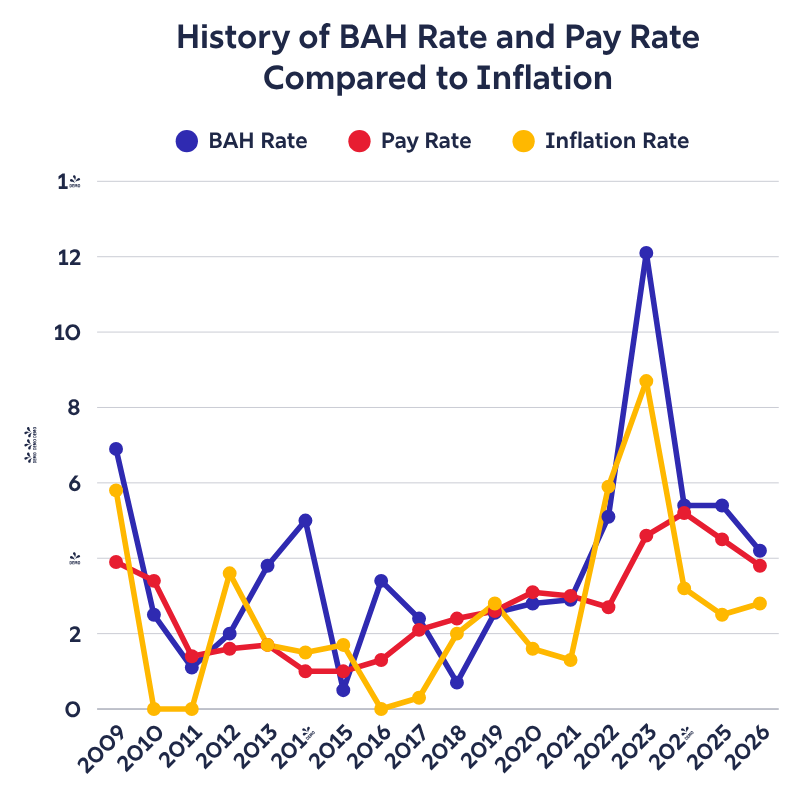
BAH rates increased an average of 4.2% in 2026, following back-to-back 5.4% increases in 2024 and 2025.
The table below shows the annual average BAH rate increase from 2009 to the present.
| Year | National Average BAH Increase |
|---|---|
| 2026 | 4.2% |
| 2025 | 5.4% |
| 2024 | 5.4% |
| 2023 | 12.1% |
| 2022 | 5.1% |
| 2021 | 2.9% |
| 2020 | 2.8% |
| 2019 | 2.55% |
| 2018 | 0.7% |
| 2017 | 2.4% |
| 2016 | 3.4% |
| 2015 | 0.5% |
| 2014 | 5.0% |
| 2013 | 3.8% |
| 2012 | 2.0% |
| 2011 | 1.1% |
| 2010 | 2.5% |
| 2009 | 6.9% |
The 12.1% increase in 2023 was unusually high and reflected significant inflation in the housing market and rising rents across most duty station areas. Increases have moderated since then, but remain higher than the pre-2022 baseline.
The chart below averages all ranks with dependents and shows the areas with the highest increases overall.
| Location | 2026 Average BAH Rate Increase |
|---|---|
| OUTER BANKS, NC | 14.43% |
| TERRE HAUTE, IN | 13.24% |
| FARGO, ND | 11.86% |
| FRANKFORT, KY | 11.30% |
| SITKA, AK | 11.17% |
| MADISON, WI | 11.11% |
| COLLEGE STATION, TX | 11.08% |
| BIRMINGHAM, AL | 11.08% |
| WEST POINT, NY | 10.90% |
| JUNEAU, AK | 10.86% |
| FORT LEONARD WOOD, MO | 10.67% |
| GRAND FORKS, ND | 10.66% |
| KETCHIKAN, AK | 10.25% |
| CHICAGO, IL | 10.25% |
| KAUAI COUNTY, HI | 10.02% |
Keep in mind that the national average does not reflect what you will see at your specific duty station. Individual markets can vary widely. In 2026, the Outer Banks, NC area saw the highest average increase for servicemembers with dependents at 14.46%, while some markets like Austin, TX saw rates decrease. Rate protection ensures that decreases in your local market do not affect your existing BAH.
BAH varies substantially depending on where you are stationed. The DoD divides the country into more than 300 military housing areas, each with its own rate table based on local rental costs. If you want to see the full picture for your pay grade, our 2026 BAH rates page breaks down every rate by rank across all locations.
Servicemembers who want to compare rates across a region or scout a potential PCS location can browse BAH rates by state, which organizes rates by state and local housing area.
If your duty station falls outside a designated housing market, your rate is set under the non-locality BAH program, which uses a national flat rate rather than a location-specific one.
Servicemembers assigned to permanent duty outside the United States do not receive BAH. Instead, they receive Overseas Housing Allowance (OHA), which is the OCONUS equivalent designed to help cover the cost of off-base housing in overseas locations.
OHA works differently from BAH. Rather than a flat rate based on your pay grade and location, OHA is a cost-reimbursement allowance. You are reimbursed for your actual rent up to a rental ceiling that is set by the DoD for your specific location, pay grade, and dependency status. In addition to the rent reimbursement, you receive a separate utility and recurring maintenance allowance to help cover monthly expenses such as electricity, gas, and water.
OHA also includes a Move-In Housing Allowance (MIHA), a one-time payment to help offset move-in costs such as security deposits, required appliances, and agency fees, where those are standard.
Because OHA is tied to local currency exchange rates, your payment can fluctuate from month to month even if your rent stays the same. The DoD updates OHA rates based on ongoing cost data and currency movements.OHA is paid to approximately 60,000 servicemembers at a cost of roughly $1.5 billion annually. To look up OHA rates for your specific overseas duty station, use the DoD OHA Rate Lookup tool.
The Monthly Housing Allowance (MHA) is a separate housing benefit administered by the Department of Veterans Affairs for servicemembers, veterans, and eligible dependents using the Post-9/11 GI Bill. It is not the same as BAH, even though both use similar rate structures.
MHA is available to:
Active duty servicemembers who live on base are not eligible for MHA, even if they are using the GI Bill. Active duty members who live off base and use the GI Bill may receive BAH but are also excluded from MHA.
While MHA uses BAH rate data as a reference point, the calculations differ. MHA is based on the housing costs at the location of your school, not your duty station or home address.Note: Online-only students receive a reduced MHA rate equal to half the national average E-5 with-dependent BAH rate.
Is BAH taxable income? No. BAH is a tax-free allowance and is not included in your taxable income. You do not report it on your federal tax return, and it does not affect your federal income tax liability.
What happens to my BAH if rates decrease in my area? Your BAH is rate-protected. If the DoD lowers BAH rates for your duty station, your existing rate stays the same as long as you remain at that duty station without a change in pay grade or dependency status. If you PCS to a new location, your BAH adjusts to the rate in effect at your new duty station on your arrival date.
Will I lose BAH if I move into base housing? Yes. BAH is only payable when government or base housing is not provided. If you move into military-owned quarters, your BAH entitlement ends. If you later move out of government housing, your entitlement resumes.
Does my BAH rate change when I get married? Yes. Gaining a dependent moves you from the without-dependent rate to the with-dependent rate for your pay grade and duty station. The with-dependent rate is higher and does not increase further based on how many dependents you have.
Can I use BAH as income on a VA loan application? Yes. Lenders count BAH as qualifying income for VA loan purposes. Because BAH is also non-taxable, lenders can typically gross it up, meaning they factor it in at a higher effective value when calculating your debt-to-income ratio. This can meaningfully increase your purchasing power.
What is the difference between BAH and OHA? BAH applies to servicemembers assigned to permanent duty within the United States, including Alaska, Hawaii, and the District of Columbia. OHA applies to servicemembers stationed overseas. Both are tax-free housing allowances calculated based on pay grade, dependency status, and local housing costs, but OHA is a reimbursement model while BAH is a flat rate.
What is BAH-Diff? BAH-Diff is a special BAH category paid to servicemembers assigned to single-type government quarters who are also required to pay child support. The amount equals the difference between the with-dependent and without-dependent BAH rate for the servicemember’s pay grade.
Your military benefits make homeownership more affordable—$0 down, no PMI, and lower average rates whether you’re buying or refinancing. See if you're eligible today.
Jon Rehagan is a 2-time Emmy Award-winning journalist who covers financial topics and military news for the veteran community. With 16 years in broadcast media (including roles in radio and television) Jon has spent his career writing, shooting, editing, and producing everything from long-form investigative specials to daily news broadcasts and digital content. His work has been recognized by the Kansas Association of Broadcasters, and he brings that same commitment to accurate, accessible reporting to helping service members, veterans, and military families navigate complex benefits and financial decisions.
Andrew Stamp served in U.S. Army special forces for more than 10 years and is currently pursuing his Chartered Financial Consultant (ChFC).
Copyright © 2026. Three Creeks Media, LLC.
Veteran.com is a property of Three Creeks Media. Neither Veteran.com nor Three Creeks Media are associated with or endorsed by any U.S. federal agency or department. The content on Veteran.com is produced by Three Creeks Media, and/or its partners, affiliates, and contractors.
The content offered on Veteran.com is for general informational purposes only and should not be construed as legal or financial advice. If you have questions that relate to your unique financial situation, please consult a financial professional, accountant or attorney to discuss. References to third-party products, rates and offers may change without notice.
Editorial Disclosure: Editorial content on Veteran.com may include opinions. Any opinions are those of the author alone, and not those of an advertiser to the site nor of Veteran.com.
Advertiser Disclosure: Veteran.com, Three Creeks Media, LLC, and its parent and affiliate companies, may receive compensation through advertising placements on Veteran.com. For any rankings or lists on this site, Veteran.com may receive compensation from the companies being ranked; however, this compensation does not affect how, where, and in what order products and companies appear in the rankings and lists. If a ranking or list has a company noted to be a “partner,” the indicated company is a corporate affiliate of Veteran.com. No tables, rankings, or lists are fully comprehensive and do not include all companies or available products. You can read more about our card rating methodology here.
Information from your device can be used to personalize your ad experience.