

If you receive VA disability compensation and have a disability rating of 30% to permanent total disability, you may be eligible for additional money as part of the monthly payments by adding qualifying dependents. If you have dependents and don’t have them on your VA benefits, it’s very important to do that as soon as possible, and this article explains why a little bit later.
This guide walks you through how to add or remove dependents, what forms you need, how the benefit works, and examples of how it affects your payment.
Who Qualifies as a Dependent?
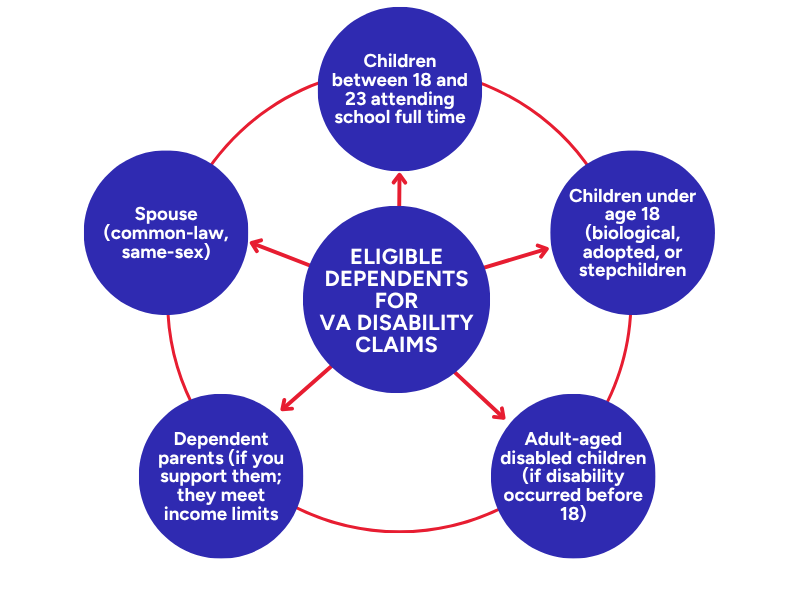
The following people are eligible to be listed as dependents:
- Spouse (including same-sex and common-law marriages, if recognized by your state)
- Children under age 18 (biological, adopted or stepchildren)
- Children between 18 and 23 attending school full time
- Adult-aged disabled children, (if disability occurred before age 18)
- Dependent parents, if you provide financial support and they meet certain income limits
How do I add or remove dependents to my VA disability benefits?
You should update your VA records any time your household changes. The biggest reason is because the VA will only allow back pay on disability pay as far back as when the claim was filed. Some types of changes you may experience regarding dependents include:
- Getting married, divorced, or legally separated
- Having a child (biological, adopted, or stepchild)
- Your child turns 18 or finishes school
- A dependent moves out or passes away
- A parent becomes financially dependent on you (or no longer is)
Example: If you get married after leaving the service, let’s say in November, but don’t file to change the dependent status until the following year in September, by the time process is reviewed and approved, the furthest back you could receive back pay is September, instead of November of the previous year, which could result in thousands of dollars you would not receive just because you waited.
Note: Conversely, using the previous example, if you get divorced in November of a year, and don’t file to remove your ex-spouse as a dependent until the following September, the VA will see this as overpayment, and request you repay some of the money you received.
How to Add a Dependent to Your VA Disability Online
Using the VA eBenefits online portal will be the fastest and is usually the most-preferred way to add a dependent to your VA disability. One of the main reasons is convenience. To do that, simply log-in to your VA account and add a dependent, and follow the prompts.
Lower, we will dive into the VA form you need to complete to add dependents, so if any of those sections are on the online application process, and you’re not sure about what to put, see the sections below.
Step-by-Step: Adding or Removing a Dependent to VA Disability by Completing VA Form 21-686C
First, you’ll need to download VA Form 21-686c. When you download it, it’s about 15 pages long, so don’t be overwhelmed. A lot of the first 5-6 pages is just laying out the possible scenarios like removing a spouse, adding a stepchild, etc. Each section is very nice as it pertains to simply explaining certain requirements needed to meet said request.
Another important thing to keep in mind is, this form is very long because it provides sections for each scenario for adding or removing dependents. That doesn’t necessarily mean you’ll be filling those sections out. In fact, you may only need to fill out 3-5 sections total, which really isn’t as tough as it may seem.
Filling out the Form
- Section one (Section I) is usually the most harmless. It’s just the veteran’s personal information. So if you’re adding a dependent, you’ll just need all your service-related/VA-related information like your veteran file number and va service number. (Most of this information you likely have access to already because you used it to initially file for VA disability.
- Section two (Section II) is for adding a spouse. This section requires information like when you got married, their name before the marriage, if they’re also a veteran (and their coinciding VA information), if you live together or not, your previous marriage information, their previous marriage history. If you haven’t been married before, this section is really easy. If not, it may take a little time to fill out.
Note: Likely worth keeping a possible copy of your marriage license on hand just to be safe. - Section three (Section III) is if you’re planning on adding children as dependents. These can be biological children, stepchildren, adopted children, adult children between the ages 18-23 plus enrolled in school, an adult child living with a medical condition that prevents them from being able to live on their own, or a child from a previous marriage that you can prove you still support financially. You’ll need to provide where the child lives. There’s a more detailed portion for stepchildren later.
- Section four (Section IV) is about removing a dependent due to a divorce. Not a long section, just one that requires the official date of divorce and the state where it happened.
- Section five (Section V) is a section that goes into a more specific addition of stepchildren to your VA disability claims. This is where you’ll go a little further into detail about their living situation, and how much of their life you’re supporting financially.
- Section six (Section VI) touches on the death of a dependent. The biggest thing you’ll need for this information is where the person passed away (city/county, state and country)
- Section seven (Section VII) is the section for you to report the marriage of a child, in the event that the child was a dependent, but now loses that dependency eligibility due to marriage.
- Section eight (Section VIII) is the section for reporting an adult child no longer attending school, thus ending their eligibility to be a dependent.
- Sections nine and ten (Section IX and Section X) are for additional remarks (section nine) and your authorization/signature confirming that everything you just filled out is factual.
So there’s your breakdown of what you’ll need for each section when filling out the VA form, and as you can see, there’s a strong chance that if you’re not adding a lot of individuals, it may not take too long.
Important things to keep in mind, regardless of who you’re planning to add to your dependency, make sure you have things like social security numbers (SSN) as well as residency information for that dependent. For children, particularly adult children in college, be sure to keep information ready that touches on their education goals, enrollment and their daily life while being enrolled.
Additional Forms Needed to Add Dependents
While the VA Form 21-686c is a key form to add dependents, there are some other forms you will need to help bolster the claims for dependents. I’ve listed them below:
- For a child over 18 in full-time school: Also submit VA Form 21-674 (Request for Approval of School Attendance).
- To add a parent as a dependent: Use VA Form 21P-509 (Statement of Dependency of Parent(s)).
Those forms should reinforce your effort to add dependents. I’d also recommend getting help with this process through an accredited Veterans Service Organization (VSO).
How Adding Dependents Affects Your Monthly Payment
Veterans rated 30% or higher are eligible for increased monthly payments based on the number and type of dependents. If you had decided to not list your dependents initially, but do have eligible dependents,
To see how much more you’d be eligible to receive, check out our VA disability pay rates page that shows the current rates, as well as tables that show the difference in your monthly benefits with dependents.
Interaction with Other VA Benefits
Adding dependents to your VA benefits will increase your monthly payments so that you can better support them. There are other benefit programs that are also available to dependents of veterans living with a service-related disability.
They range from benefits available if the veteran dies because of their service, to just additional benefits for things like education.
Final Thoughts
The biggest takeaway I’d say I hope you take away from this article if you’re a veteran: If you have dependents and haven’t filed a claim yet, be sure to remember them. If you receive VA disability benefits and gain a dependent or never listed them, file to add them immediately, because you’re likely not receiving thousands of dollars you’ve earned and are eligible to receive each month.
But, make sure to stay on top of those dependents if they either age out of eligibility or are no longer a part of your family, because if you don’t the VA will make you pay back money you’ve received for them being listed as your dependent.
I hope this article helps if you’re needing help filing out a form, but make sure that if you have any other questions, or aren’t sure about the process, to reach out to a VSO or a VA representative.
Adding or removing a dependent might seem like a lot of paperwork, but it’s also about taking care of your family. You’ve earned that support — make sure they get it.
-
Jon Rehagan covers financial topics and military news, aimed at helping those who've served our country and everyday civilians